

Soviet Forces Break German Lines as Red Army Reaches Peak Power in Eastern Front Offensive, September 1943
1943Eastern Front, Soviet Union
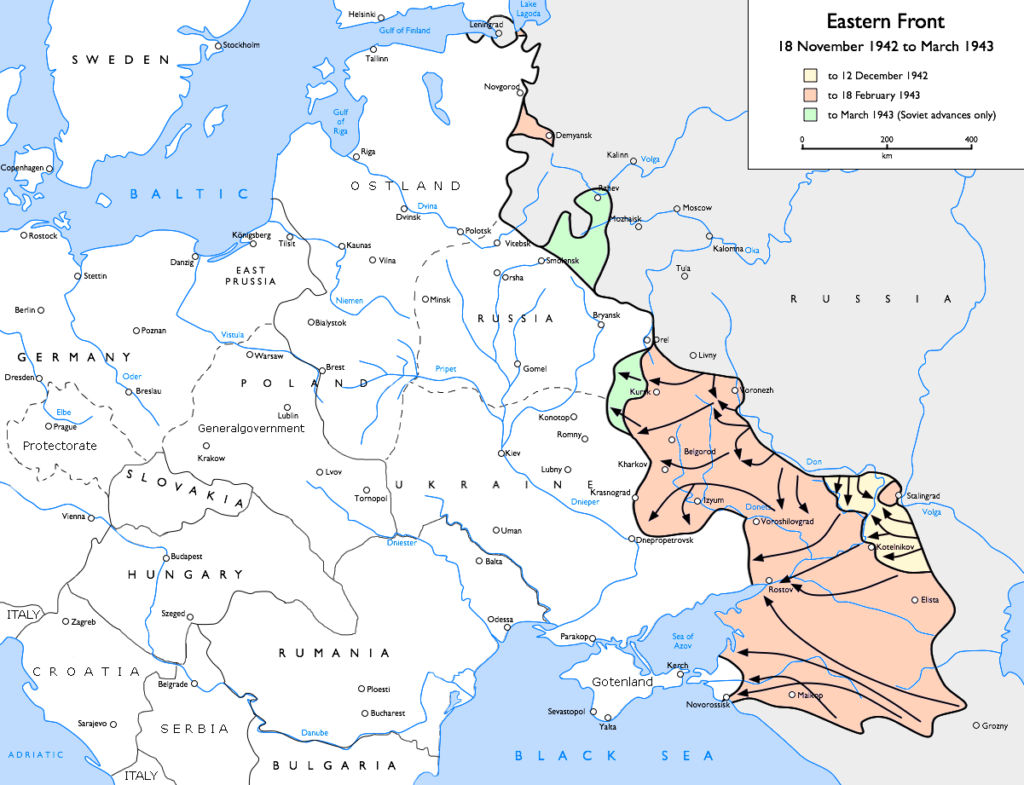
By September 1943, the tide of World War II’s most brutal theater was turning decisively. As autumn approached on the Eastern Front, Soviet forces demonstrated a resilience and strength that would reshape the entire conflict, forcing German armies into what military observers recognized as the beginning of their long retreat westward.
Eastern Europe’s Cold War Borders Born
The Eastern Front had raged for over two years since Germany’s invasion of the Soviet Union in June 1941. After the catastrophic defeats of 1941 and 1942, the Red Army had gradually rebuilt its strength, learning from earlier disasters and benefiting from increased material support. The summer of 1943 had seen the massive tank battle at Kursk, where German offensive capabilities were finally broken.
Red Army Proves Offensive Superiority
Reports from September 12, 1943, revealed the scope of Soviet success across multiple sectors of the Eastern Front. The fall of Stalino and advances in the Taganrog sector demonstrated what military analysts described as unprecedented Soviet momentum. The Detroit Evening Times reported that the “Russian army is now at the peak of its power,” noting that Soviet forces had proven themselves “far stronger and more skillfully handled” than German commanders had anticipated.
“Russian army is now at the peak of its power
— Detroit Evening Times, September 12, 1943
FROM THE ARCHIVE
Like reading history this way?
Get one of these stories delivered every day. Free.
SUBSCRIBE →The Red Army’s offensive capabilities extended across an “ever widening front,” with Soviet troops showing remarkable endurance after “two months of savage fighting.” This resilience particularly impressed military observers, as it indicated the Red Army had evolved from the defensive force of earlier years into an offensive juggernaut capable of sustained operations.
German forces found themselves compelled to withdraw toward defensive positions along the Dnieper River, stretching from Dnepropetrovsk and Zaporozhe southward to Melitopol and the Sea of Azov. This retreat represented not just tactical withdrawal but a fundamental shift in German strategic planning on the Eastern Front.
Stalino Falls as Dnieper Retreat Begins
The September 1943 offensive marked a crucial turning point in the war’s eastern theater. For the first time, German forces faced a Soviet army that could maintain offensive operations across multiple fronts simultaneously while demonstrating superior tactical coordination. The Red Army’s ability to advance steadily while maintaining combat effectiveness after prolonged fighting indicated that Soviet military reforms and industrial mobilization had finally reached maturity.
The German retreat to the Dnieper line represented the abandonment of territory that had been occupied since 1941, including vital industrial regions and agricultural areas. More critically, it demonstrated that German defensive capabilities could no longer contain Soviet offensive power, presaging the long series of retreats that would eventually lead to Berlin.
Two Years After Barbarossa’s Launch
The Soviet breakthrough of September 1943 established the military dynamics that would shape post-war Europe for decades. The Red Army’s demonstrated superiority on the Eastern Front directly influenced the eventual Soviet occupation of Eastern Europe and the Cold War division of the continent. Modern NATO’s eastern expansion and current tensions over Ukraine can be traced directly to the geopolitical realities established when Soviet forces first proved capable of sustained offensive operations against German defenses in 1943.
Sources
- Detroit Evening Times, September 12, 1943 — Library of Congress