

King George VI Makes Secret Flight to North Africa to Inspect Allied Forces, June 1943
1943Algiers, Algeria
In the pre-dawn darkness of a Windsor Castle Friday night in June 1943, King George VI slipped away from his royal residence under the tightest secrecy. His destination: the blazing heat of North Africa, where Allied forces were massing for what would prove to be one of the war’s most crucial campaigns. The monarch’s clandestine journey would mark an unprecedented moment in modern royal history—a reigning British sovereign flying into an active theater of war.
The Secret Mission
The King’s four-motor aircraft, piloted by his personal aviator Group Captain E.H. Fielden, touched down at the Algiers airfield at 8 a.m. on Saturday morning. Only a handful of officers and startled mechanics witnessed the historic moment as His Majesty “stepped from the fourmotor plane wearing the uniform of a field marshal.” The secrecy had been so complete that even most military personnel at the airfield were caught off guard by the royal arrival.
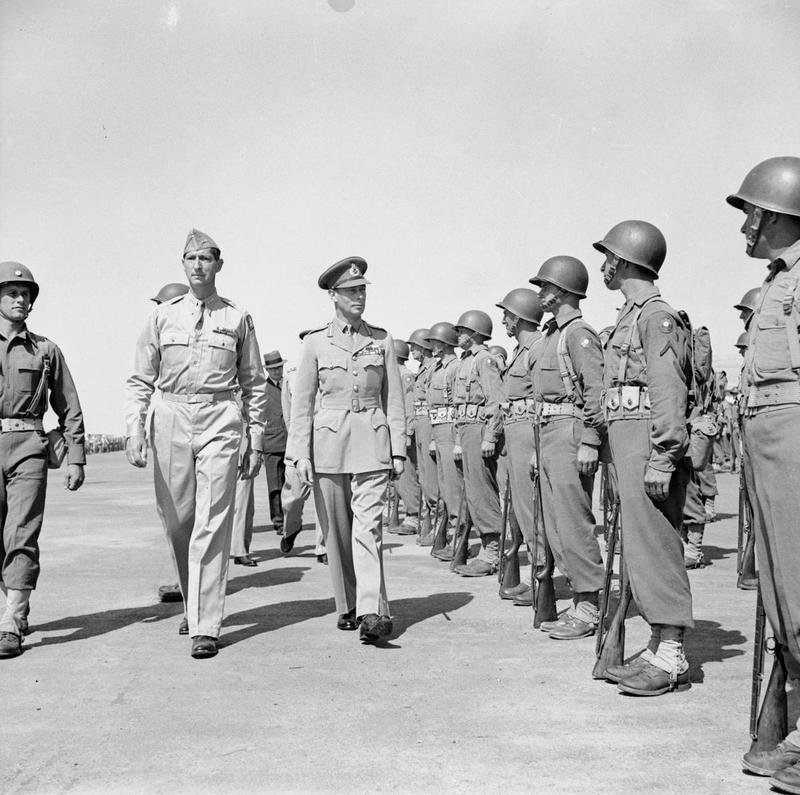
George VI, who had earned his pilot’s commission in 1919 and was no stranger to aviation, had planned this dangerous journey for weeks. Accompanied by high Cabinet officers, the monarch immediately began an extensive inspection tour of Allied forces scattered across the North African theater. From beachheads to battleships, from field hospitals to forward positions, the King moved among American and British troops who greeted him with spontaneous choruses of “For He’s a Jolly Good Fellow.”
“stepped from the fourmotor plane wearing the uniform of a field marshal
— The Washington Daily News, June 16, 1943
FROM THE ARCHIVE
Like reading history this way?
Get one of these stories delivered every day. Free.
SUBSCRIBE →Strategic Timing and Psychological Warfare
The timing of the King’s visit was no accident. Allied forces were in the final stages of preparation for Operation Husky—the invasion of Sicily—which would begin just weeks later. As the monarch toured the preparations, Allied bombers were already conducting round-the-clock attacks on Sicilian airfields, hammering targets at Bocca Di Falco, Castelvetrano, Sciacca, and Borizzo in what military commanders described as “a shattering night and day bombardment.”
But the King’s presence served a purpose beyond morale. His secret flight contributed to what intelligence officers called “a war of nerves” that left Axis forces “floundering amid wild speculation on the imminence of an invasion somewhere on the rim of Europe.” German and Italian commanders, already struggling to predict where the Allies would strike next, found themselves further confounded by the unprecedented royal visit.
Breaking Royal Protocol
Never before in modern British history had a reigning monarch ventured so close to active combat zones. The decision reflected both George VI’s personal commitment to the war effort and the critical importance of the North African campaign to Allied strategy. The King’s willingness to risk his life alongside his subjects sent a powerful message throughout the Empire and beyond.
During his tour, the King also decorated General Dwight D. Eisenhower, the Supreme Allied Commander who would soon lead the Sicily invasion. This ceremonial moment, conducted under the North African sun rather than in the formal setting of Buckingham Palace, symbolized how completely the war had transformed traditional protocols and expectations.
Why It Still Matters
The King’s 1943 flight established a precedent for modern royal engagement in military affairs that continues today. When members of the current royal family visit troops in Afghanistan, Iraq, or other conflict zones, they follow a tradition of personal commitment to military service that George VI helped establish during World War II. The concept of the monarch as an active participant rather than distant figurehead in times of national crisis remains a defining characteristic of the modern British constitutional monarchy.
Sources
- The Washington Daily News, June 16, 1943 — Library of Congress