

New York Prepares Massive Public Viewing for Admiral Dewey’s Triumph, 1899
1899New York, New York
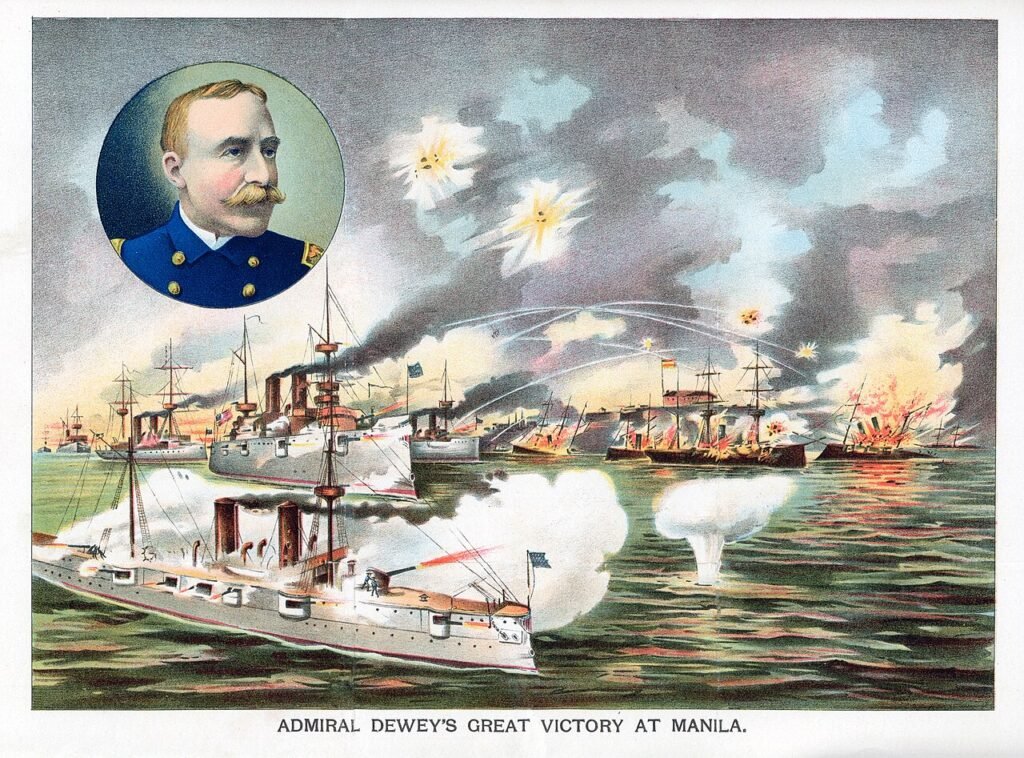
The sounds of hammers and saws echoed across Manhattan as New York City transformed itself into a stage worthy of America’s newest naval hero. In early September 1899, workers raced to complete massive viewing stands that would accommodate tens of thousands of spectators eager to witness Admiral George Dewey’s triumphant homecoming parade.
Victory Parade Template Born
Admiral Dewey had become a national sensation following his decisive victory over the Spanish fleet at Manila Bay in May 1898. His tactical brilliance during the Spanish-American War made him the most celebrated military figure since the Civil War. Now, more than a year later, the “Hero of Manila” was finally returning home to a hero’s welcome that New York was determined to make unforgettable.
America’s New Imperial Confidence
The scale of preparation was staggering. A special reception committee had determined locations for public viewing stands throughout the city, with capacity totaling over 25,000 seats. The largest installation rose at Fifty-ninth Street, designed to hold 9,000 spectators. City Hall Park would accommodate 5,200 viewers, while Riverside Drive at One Hundredth Street offered seating for 5,500. Smaller but still substantial stands were planned for strategic points along the parade route, including 2,200 seats on the south side of Madison Square and 1,800 directly “opposite the Triumphal Arch.”
The entertainment matched the ambition of the physical preparations. Two of New York’s most prestigious musical organizations, the Arion and Liederkranz Societies, were combining forces to create a grand chorus for the occasion. These German-American singing societies, known for their musical excellence and cultural prominence, would provide a soundtrack befitting the magnitude of the celebration.
FROM THE ARCHIVE
Like reading history this way?
Get one of these stories delivered every day. Free.
SUBSCRIBE →Yet even as construction crews worked frantically, the reception committee acknowledged that “the route of the Dewey land parade” remained subject to potential changes. The complexity of coordinating such an enormous public event, involving multiple city departments and countless private preparations, created ongoing challenges right up to the final days.
Twenty Five Thousand Seats Rising
The Dewey celebration represented more than just honoring a military hero—it marked America’s emergence as a global naval power. The Spanish-American War had established the United States as an imperial force, and Dewey’s victory symbolized this new status. The elaborate preparations reflected both civic pride and national confidence in America’s expanded role on the world stage.
The involvement of German-American cultural societies also highlighted the complex ethnic tapestry of turn-of-the-century New York. Despite rising tensions in Europe and growing nativism in some quarters, the city’s German community remained deeply integrated into major civic celebrations, demonstrating the continued importance of immigrant communities in American public life.
Manila Bay Hero’s National Fame
The massive public investment in the Dewey celebration established a template for twentieth-century American victory parades. The coordination between municipal authorities, private organizations, and cultural groups created a model that would be replicated for future military homecomings and civic celebrations. The event also demonstrated New York’s growing capacity to stage spectacles that matched its ambitions as America’s premier metropolis.
More broadly, the celebration marked a pivotal moment in American cultural history—the transition from a nation that had recently concluded its own civil war to one confident enough to project power globally and celebrate its military achievements with unprecedented pageantry.
Sources
- New York Journal and Advertiser, September 9, 1899 — Library of Congress