

Georgia Voters Face Private School Amendment as Segregation Crisis Deepens, 1954
1954Augusta, Georgia
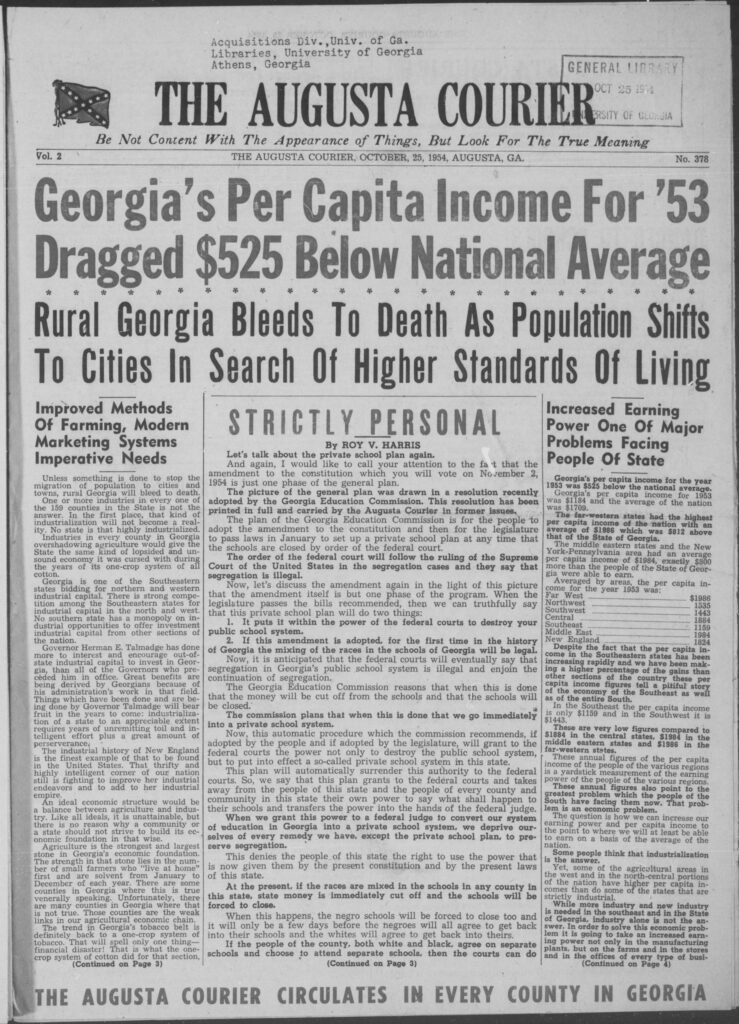
As Georgia voters prepared for a pivotal November 2, 1954 election, a controversial amendment threatening to dismantle the state’s public school system exposed the deepening crisis over racial integration in Southern education. The so-called private school amendment, crafted as a response to federal desegregation orders, would fundamentally alter how Georgia educated its children—if voters approved it.
Modern Voucher Wars Echo 1954
The amendment emerged in the aftermath of the Supreme Court’s Brown v. Board of Education decision in May 1954, which declared racial segregation in public schools unconstitutional. Southern states scrambled to find ways to maintain segregated education while technically complying with federal mandates. Georgia’s legislature, like others across the South, proposed transferring public schools to private control as a potential workaround.
The state had invested heavily in its public education infrastructure over previous decades, building a comprehensive system that served communities across all 159 counties. Rural areas, already struggling with population migration to cities and economic challenges, particularly depended on public schools as anchors for their communities.
“There is grave danger that the citizens of Georgia in the November 2 election will vote to destroy their public system
— The Augusta Courier, October 25, 1954
Privatization Plan Threatens Rural Counties
By late October 1954, opposition to the private school amendment was crystallizing among unexpected quarters. The Augusta Courier warned that “there is grave danger that the citizens of Georgia in the November 2 election will vote to destroy their public system because of their ignorance of what they are doing.” Critics argued that amendment supporters were deliberately keeping voters uninformed about the measure’s potential consequences.
FROM THE ARCHIVE
Like reading history this way?
Get one of these stories delivered every day. Free.
SUBSCRIBE →
The League of Women Voters of Georgia emerged as a vocal opponent of the amendment, challenging the notion that privatization would guarantee continued segregation. Meanwhile, proponents insisted the measure offered the only viable path to maintain racial separation in schools while avoiding direct defiance of federal court orders.
The debate revealed fundamental tensions within Georgia’s political establishment. While segregationists viewed the amendment as essential protection for their way of life, others feared it would devastate public education infrastructure built over generations. The amendment’s language suggested that private operators could receive public funding, but critics questioned whether such arrangements would survive legal challenges.
November 2 Amendment Sparks Fierce Opposition
The private school amendment represented one of the earliest and most comprehensive attempts by a Southern state to circumvent Brown v. Board through systematic privatization. Unlike piecemeal resistance efforts in other states, Georgia’s proposal would have transformed the entire educational landscape overnight.
The controversy highlighted the broader dilemma facing the South: how to maintain segregation without appearing to directly defy federal authority. The amendment’s supporters believed they had found a legal loophole, while opponents argued it would create chaos without achieving its intended goals.
Rural Georgia’s economic struggles, already evident in declining agricultural income and urban migration, added another layer of complexity. The state’s per capita income lagged $525 behind the national average, making educational investments crucial for long-term development. Dismantling public schools risked further weakening rural communities’ economic prospects.
Brown Decision Shakes Georgia Schools
Georgia’s 1954 private school amendment foreshadowed modern school choice debates, where voucher programs and charter schools often emerge in communities grappling with integration and equity issues. The fundamental tension between local control and federal oversight in education policy continues to shape American politics today, from recent controversies over curriculum content to ongoing battles over school funding formulas.
Sources
- The Augusta Courier, October 25, 1954 — Library of Congress