

Canada Announces $1.2 Million Compensation for Japanese Evacuation Losses, 1950
1950Ottawa, Ontario, Canada
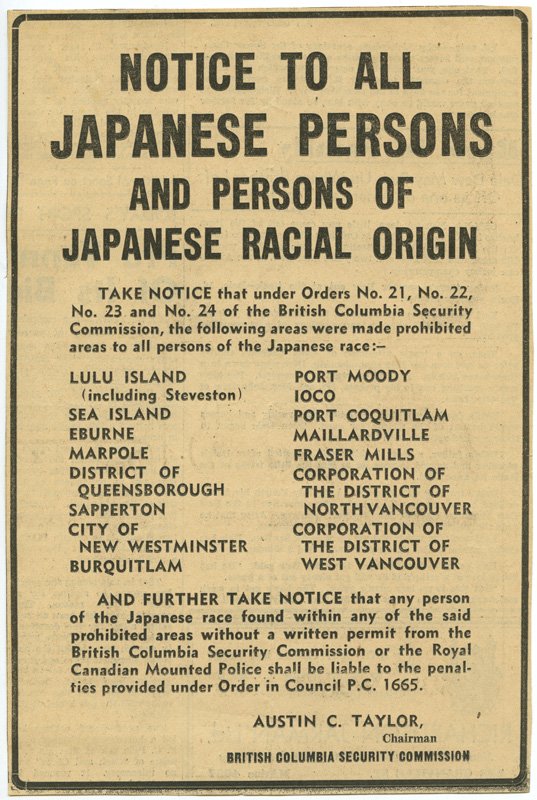
In a landmark decision addressing one of Canada’s most controversial wartime policies, the federal government announced it would pay $1,228,829 in compensation to Japanese-Canadians who suffered property losses during their forced evacuation from the Pacific Coast during World War II. The announcement, made public in late June 1950, represented the culmination of a painstaking three-year investigation into thousands of claims for losses sustained during the mass removal and internment of over 22,000 people of Japanese ancestry.
Blueprint for Canada’s 1988 Redress Movement
Following the attack on Pearl Harbor in December 1941, fear and racial prejudice combined to create one of the darkest chapters in Canadian civil liberties history. Under the War Measures Act, the Canadian government forcibly removed all persons of Japanese ancestry from a 100-mile coastal zone in British Columbia, citing national security concerns. Families were given just days to dispose of their properties, businesses, and possessions before being transported to internment camps in the interior of British Columbia and other provinces.
The hasty nature of the evacuation meant that properties were often sold far below market value by the government-appointed Custodian of Enemy Property. Homes, farms, fishing boats, and businesses that represented lifetimes of work were liquidated at prices that bore little resemblance to their true worth. For nearly a decade after the war’s end, the financial devastation remained unaddressed as the community struggled to rebuild their lives.
The Investigation
Justice Bird’s royal commission began its work on December 8, 1947, and concluded on March 3, 1950, examining what would prove to be a staggering volume of claims. Over the course of more than two years, the commissioner “examined 2420 claims and 102 claims were either rejected or withdrawn,” according to reports from the investigation. The process was exhaustive, requiring detailed documentation of pre-war property values and the circumstances of their disposal.
FROM THE ARCHIVE
Like reading history this way?
Get one of these stories delivered every day. Free.
SUBSCRIBE →The investigation revealed particularly egregious undervaluation in the Fraser Valley district, where valuable agricultural land had been transferred to the Veterans Land Act administration and subsequently sold to returning servicemen at prices well below assessed values. Properties that had been turned over to the VLA “for a sum less than the assessed value” totaling $751,000 would receive additional compensation of $801,500 under the commissioner’s recommendations.
Justice Bird’s Three Year Claims Investigation
The compensation announcement represented the first formal acknowledgment by the Canadian government that the property disposal process had been fundamentally unfair. While the financial redress could not fully restore what had been lost, it marked an important precedent for government accountability in matters of civil rights violations during wartime.
The investigation’s findings also highlighted the broader economic impact of the evacuation policy on the Japanese-Canadian community. Beyond individual hardship, entire neighborhoods and business districts had been dismantled, severing economic relationships and community networks that had taken decades to develop.
Pearl Harbor Sparks Mass Pacific Coast Removal
The 1950 compensation package, while significant for its time, would later be viewed as incomplete redress for the full scope of losses suffered during the evacuation. The investigation focused primarily on tangible property losses but did not address broader questions of lost income, educational opportunities, or the psychological trauma of forced displacement.
The precedent established by Justice Bird’s commission would inform future discussions about reparations for historical injustices in Canada. The methodical documentation of claims and losses provided a framework that would be referenced in later efforts to address similar grievances. However, it would take nearly four more decades before the Canadian government would offer a fuller acknowledgment and apology for the evacuation policy, along with additional compensation, in 1988.
Sources
- The Northwest Times, June 24, 1950 — Library of Congress