Allied Forces Prepare Triple Assault on Hindenburg Line, September 1918
1918Western Front, France
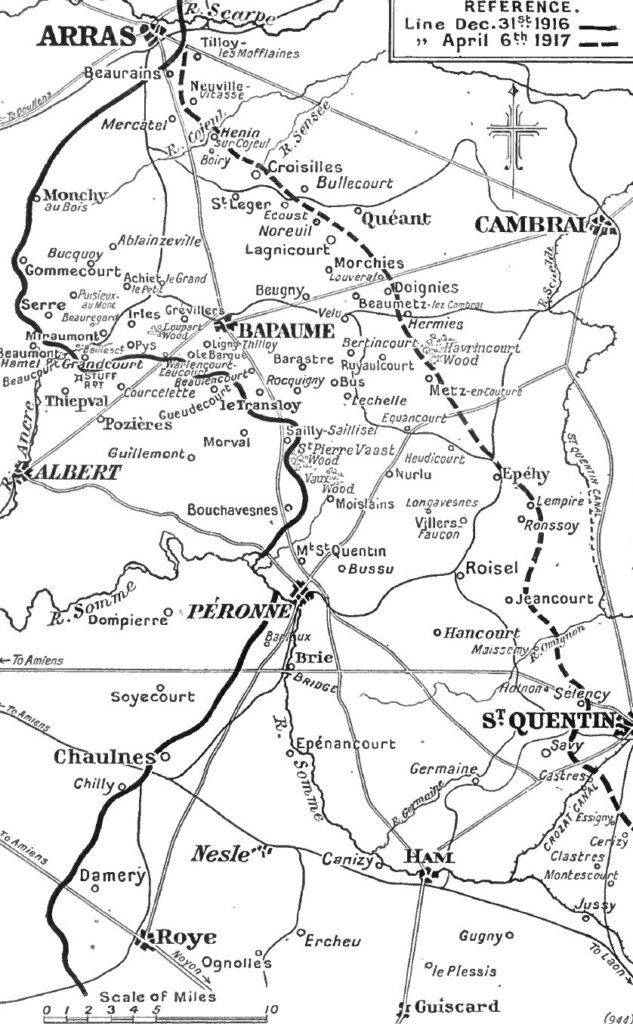
The war’s tide was turning decisively as September 1918 began. After four grueling years of trench warfare, three Allied armies were positioning themselves for what military observers believed could be the decisive blow against Germany’s most formidable defensive barrier—the Hindenburg Line. The coordination of this massive offensive represented the culmination of hard-learned lessons in modern warfare.
Blueprint for Modern Combined Warfare
The Hindenburg Line, constructed by German forces in 1916-1917, represented the pinnacle of defensive engineering. Stretching across northern France, this system of fortified positions, concrete bunkers, and multiple trench lines had withstood numerous Allied assaults. Named after German Field Marshal Paul von Hindenburg, the line was considered virtually impregnable by military experts on both sides.
Throughout 1918, however, the strategic situation had shifted dramatically. The failure of Germany’s spring offensive and the arrival of fresh American troops had transformed the Western Front. The successful Allied counteroffensives of summer 1918 had pushed German forces back toward their prepared defensive positions, setting the stage for this climactic confrontation.
Breaking Germany’s Final Insurance Policy
As reported in New York’s The Sun on September 8, 1918, “three armies draw in for triple blow” against the German fortifications. This coordinated assault represented unprecedented cooperation between British, French, and American forces, each approaching different sections of the defensive line simultaneously.
The newspaper noted that “rapid gains in Picardy” were already indicating that German resistance was weakening. These advances in the Picardy region, north of Paris, suggested that the elaborate defensive system that had held for so long might finally be vulnerable to sustained, coordinated pressure.
FROM THE ARCHIVE
Like reading history this way?
Get one of these stories delivered every day. Free.
SUBSCRIBE →The scale of preparation for this offensive was enormous. Supply lines stretched back hundreds of miles, ammunition depots were established at forward positions, and artillery pieces were positioned for the preliminary bombardment that would precede the infantry assault. The logistics alone represented a masterpiece of military organization, coordinating the movements and supplies of hundreds of thousands of troops.
Three Allied Armies Converge
This pending assault represented far more than another military operation—it was potentially the beginning of the end of the Great War. The Hindenburg Line had been Germany’s insurance policy, the final defensive barrier behind which they could reorganize and continue the fight. If this line could be breached and held, German resistance might collapse entirely.
The timing was crucial. German morale was already suffering from supply shortages, war weariness at home, and the realization that American reinforcements were arriving faster than German forces could be replaced. A successful breach of the Hindenburg Line would likely trigger a general German retreat, possibly leading to armistice negotiations.
The coordination between Allied forces also marked a new level of military cooperation. Previous offensives had often suffered from poor communication between national commands and conflicting objectives. This triple assault demonstrated that the Allies had finally learned to fight as a unified force rather than separate national armies operating in the same theater.
Germany’s Impregnable Fortified Barrier
The preparations for this assault would indeed prove to be among the final major operations of World War I. The breaking of the Hindenburg Line, when it came, would contribute directly to Germany’s decision to seek an armistice in November 1918. The lessons learned in coordinating this massive offensive would influence military strategy for decades to come.
The success of this coordinated approach would validate new theories of combined arms warfare and international military cooperation. These tactical and strategic innovations would reshape how future conflicts were planned and executed, marking the end of the era of static trench warfare that had defined much of the Great War.
Sources
- The Sun, September 8, 1918 — Library of Congress