

Whooping Cough Outbreak Strikes Nevada Mining Community, 1900
1900Gardnerville, Nevada
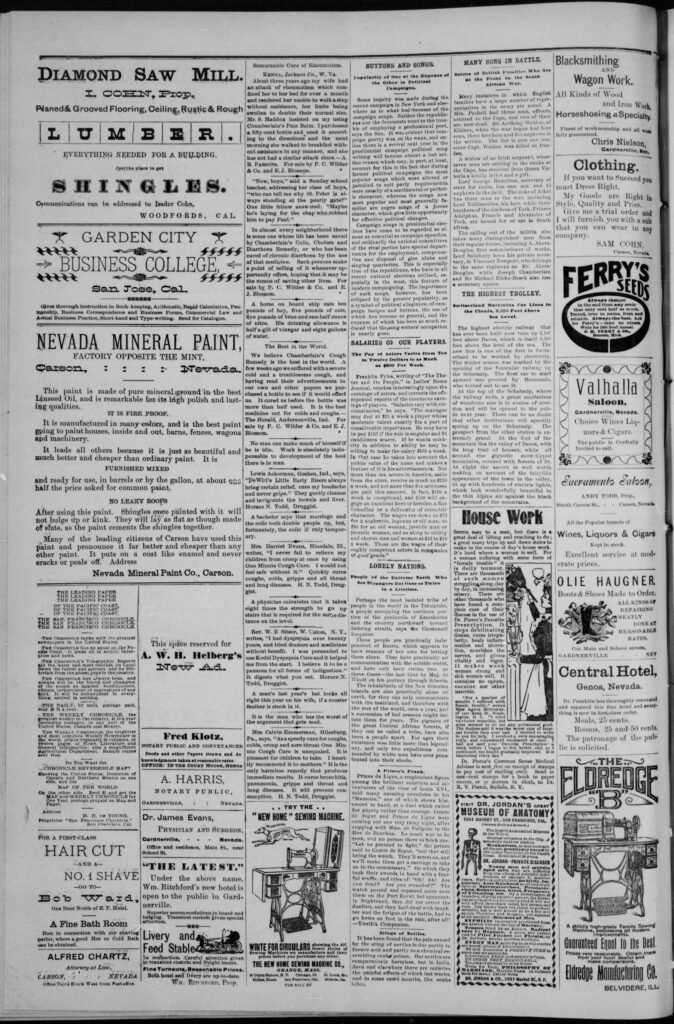
In the spring of 1900, the small mining community of Gardnerville, Nevada, found itself in the grip of a medical crisis that would test the resilience of frontier life. As miners worked the surrounding hills and families settled into the rhythm of territorial existence, an invisible enemy swept through their ranks with devastating efficiency.
Rural Nevada’s Public Health Awakening
Gardnerville, nestled in Douglas County’s Carson Valley, represented the hopeful spirit of western expansion at the dawn of the twentieth century. The community boasted essential frontier amenities: the East Fork Hotel offered “clean, comfortable rooms” for travelers, local sawmills provided building materials, and a weekly newspaper, The Courier, kept residents connected to the wider world. Yet for all its growing sophistication, Gardnerville remained vulnerable to the same infectious diseases that plagued isolated communities across the American West.
Whooping cough, known medically as pertussis, had terrorized communities for centuries. The bacterial infection attacked the respiratory system, causing violent coughing fits that could last for months. In an era before antibiotics or effective vaccines, the disease proved particularly dangerous for children, often leading to pneumonia, brain damage, or death. Frontier towns like Gardnerville, with limited medical resources and crowded living conditions, provided ideal breeding grounds for such epidemics.
“Nearly onehalf the children in Gardnerville school district are down with whooping cough
— The Courier, April 6, 1900
FROM THE ARCHIVE
Like reading history this way?
Get one of these stories delivered every day. Free.
SUBSCRIBE →Epidemic Exposes Western Medical Isolation
By early April 1900, the outbreak had reached alarming proportions. As reported in The Courier on April 6th, “Nearly onehalf the children in Gardnerville school district are down with whooping cough.” The stark simplicity of this statement masked a community crisis that likely disrupted every aspect of daily life in the small Nevada settlement.
The timing proved particularly cruel. Spring typically brought renewal and optimism to mining communities, with improved weather allowing for increased economic activity. Instead, Gardnerville found itself grappling with the logistics of caring for dozens of sick children while maintaining the essential functions of frontier life. Parents faced the dual challenge of nursing their own families while continuing the work necessary for community survival.
The epidemic struck during a period of broader regional development. County officials were planning court sessions, residents were preparing for upcoming school trustee elections, and local businesses were advertising their wares. The outbreak forced families to balance these normal community activities against the urgent demands of a public health crisis.
Half of Gardnerville Children Stricken
The Gardnerville outbreak illuminated the precarious nature of frontier public health in turn-of-the-century America. Unlike established eastern cities with hospitals and medical colleges, western communities relied on limited local resources and the hope that epidemics would burn themselves out before causing irreparable damage. The fact that nearly half of school-age children fell ill demonstrated both the virulence of the disease and the interconnected nature of small-town life, where children from scattered ranches and mining claims gathered daily in a single schoolhouse.
The epidemic also highlighted the role of local newspapers in documenting public health crises. The Courier’s matter-of-fact reporting style reflected the frontier acceptance of hardship while providing future historians with crucial evidence of how infectious diseases shaped community life in the American West. Such outbreaks influenced settlement patterns, economic development, and the eventual establishment of more robust public health infrastructure.
Carson Valley’s Frontier Vulnerability
The 1900 Gardnerville whooping cough outbreak foreshadowed the ongoing challenges of infectious disease control in isolated communities. Today’s rural hospitals and public health departments trace their origins to the recognition that frontier settlements needed organized medical responses to epidemics like the one that struck Nevada’s Douglas County. Modern vaccine programs that have nearly eliminated whooping cough in developed nations represent the culmination of lessons learned from outbreaks like Gardnerville’s, where entire communities watched helplessly as disease swept through their most vulnerable populations.
Sources
- The Courier, April 6, 1900 — Library of Congress