

Niagara Power Company Tests Revolutionary Industrial Electricity at Niagara Falls, 1895
1895Niagara Falls, New York
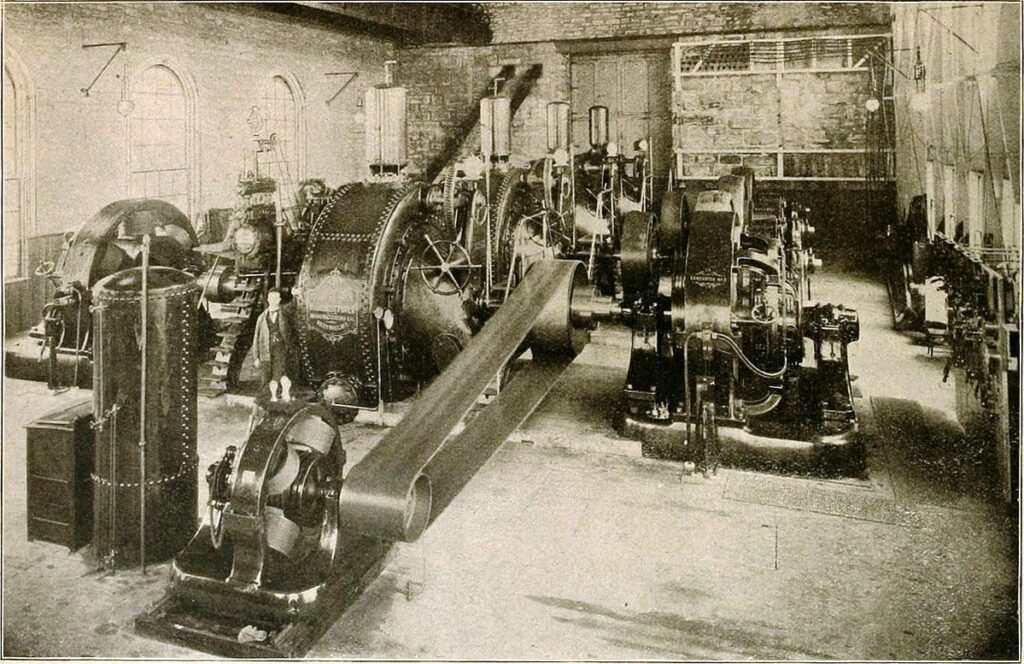
The thunderous roar of Niagara Falls took on new meaning in July 1895 as engineers pushed massive electrical generators to unprecedented speeds, their machinery shrieking like distant locomotives as they tested the boundaries of what was possible. The Niagara Power Company’s ambitious project to harness one of nature’s most powerful forces had reached a critical juncture, with daily tests proving that electricity could be generated on an industrial scale never before imagined.
Buffalo Powers the Modern Electrical Age
While most Americans in 1895 were just beginning to hear about “harnessing Niagara,” the falls had actually been put to practical use for more than thirty years. Early mills and factories had long relied on the waterway’s mechanical power, but the Niagara Power Company envisioned something far grander: converting the falls’ hydraulic energy into electrical power that could be transmitted over long distances to fuel the growing industrial economy.
The company’s “expensive and elegant plant” represented a massive investment in untested technology. Engineers were essentially writing the rulebook for large-scale electrical generation as they worked, with no precedent to guide their efforts beyond theoretical calculations and smaller experimental installations.
Industrial Scale Electricity Becomes Reality
Throughout July 1895, one of the “giant machines” underwent rigorous daily testing that pushed both equipment and nerves to their limits. Engineers began cautiously, running the generators at a conservative 100 revolutions per minute. The process required extraordinary vigilance, as the chief engineer would leap to his feet whenever he heard what sounded like “the long drawn shriek of a distant locomotive” to search for machinery that needed immediate attention.
The stakes could hardly have been higher. As one observer noted, “it is no joke” to operate such massive equipment at the edge of its capabilities. A catastrophic failure could destroy months of work and enormous financial investment, not to mention potentially injure or kill workers in the vicinity.
FROM THE ARCHIVE
Like reading history this way?
Get one of these stories delivered every day. Free.
SUBSCRIBE →Yet by July, the engineers had successfully increased the generator speed to 250 revolutions per minute, more than double the initial testing rate. Each successful run demonstrated the feasibility of the entire scheme and brought the company closer to full commercial operation.
Giant Machines Shriek at 250 RPM
The successful tests at Niagara Falls in July 1895 represented a watershed moment in the history of electrical power. Unlike the small-scale electrical systems that had powered individual buildings or city blocks, the Niagara project promised to generate electricity on an industrial scale that could power entire cities and manufacturing districts.
The project’s success would prove that hydroelectric power could be a reliable, large-scale alternative to coal-fired steam plants. This had profound implications for American industry, particularly in regions where coal was expensive or difficult to transport. The ability to generate massive amounts of clean, renewable electricity would reshape manufacturing patterns and urban development across the continent.
Moreover, the technical achievements at Niagara Falls would establish American engineers as world leaders in electrical power generation, setting the stage for the rapid electrification that would define the next century of American economic development.
Thirty Years of Mechanical Mills
The Niagara Power Company’s successful tests in 1895 marked the beginning of the modern electrical age in America. Within a few years, the installation would be supplying power to Buffalo and other distant cities, proving that electricity could be transmitted efficiently over long distances.
The project became a model for hydroelectric development worldwide, inspiring similar installations from the Colorado River to the Tennessee Valley. The engineering principles and safety protocols developed during those tense July tests would guide electrical engineers for generations, establishing standards for large-scale power generation that remained relevant well into the twentieth century.
Perhaps most significantly, the success at Niagara Falls demonstrated that American industrial ingenuity could tame even the most powerful natural forces, reinforcing the nation’s growing confidence in its technological capabilities as it approached the new century.
Sources
- New-York Tribune, July 8, 1895 — Library of Congress